
Here’s the Sun, Joe
What 29 years of grief after my brother’s suicide has taught me about story, awakening, and learning to breathe again

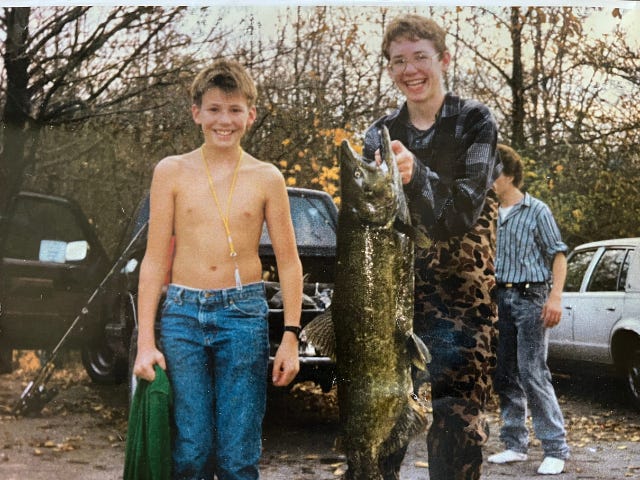
Greetings! If you’re new to the Writing Your Resilience Substack, welcome! I’m Lisa Cooper Ellison, a trauma-informed writing coach, author of this Substack, and your resident story alchemist. If you’ve been here for a while, welcome back. It’s wonderful to be with friends.
On Sunday, I walked in the sun to honor my brother, Joe.
In the weeks leading up to his suicide on February 8, 1997, the sky in our upstate New York hometown was blanketed in thick, gray clouds like a great iron dome. A few days before his death, he asked my mother, “Will the sun ever come out?”
For him, it never did—at least not in his lifetime.
The county I grew up in has some of the lowest sunshine totals in the state, with long stretches of winter cloud cover that cause depression levels to spike. This winter in Virginia has been as blustery and snowy as some I experienced during childhood, but here, sunny days are common. And so, on Sunday afternoon, I stepped off the porch, put on my anniversary playlist (starting with “Smells Like Teen Spirit”) and whispered, “Here’s the sun, Joe. Here it is.”
Over the past twenty-nine years, I’ve learned that grief is more than an emotional or physiological response. Grief is a story we carry. Like all stories, it evolves over time.
In the beginning, when grief howled in the hole left by Joe’s death, the story I carried was that my life was over. A few weeks after the funeral, I stood in front of a lake in the Swiss Alps as the sun set behind a snowy peak, asking the earth, air, and water to show me how to go on.
There was only silence…until the stars came out, glimmering in the fabric of night, reminding me that light exists even in the dark.
Two years later, I inhabited the story of living two lives: one for myself and one to make up for the brother my family had lost. I thought achievement would break the chains of guilt I carried. All it did was wear me out until one day, I sat on the top level of the parking garage at the university I attended so depressed that I didn’t even realize I was quietly planning to check out.
Luckily for me, an experience not long after my brother’s death led to a promise to live. As I looked over the parking garage’s top deck, I remembered that promise and made an appointment with a therapist. Over the next two years, I learned how to process the pain I carried. Healing didn’t erase the crack Joe’s death created in my heart. But over time, I came to understand that this chasm didn’t only hold pain; it held love and compassion that I would one day offer myself.
Lately, while working on a memoir about near-death experiences, tentatively titled Breathe, Baby Breathe, I’ve been thinking about my brother’s death as a catalyst.
In storytelling, a catalyst disrupts the main character’s ordinary life and forces them out of their comfort zone. Some catalysts arrive gently; others charge onto the scene. Either way, they mark the end of life as we know it. We can choose whether to move forward or cling to the status quo, but we cannot return to the innocence we once held.
While my brother’s suicide isn’t the catalyst in my current book, reflecting on how it serves as a catalyst in my life gives me another way to revise the story I carry.
Before Joe died, I believed feeling pain made you weak. After, sorrow became a constant companion. I had to learn not just how to live with it, but to truly live. Learning how to live alongside deep grief helped me become more loving, more open-hearted, and more awake to the marvels of this world.
When I look back now, I see Joe’s death as one of the great awakenings in my life; it connected me to a greater love while also teaching me one of the hardest lessons we ever face: not everyone gets to grow old.
That’s the truth I sat with on Sunday as my playlist ended and Spotify’s algorithm fed me additional songs. With each new tune, I whispered thank you: thank you for twenty years of good times. Thank you for helping my heart grow. Thank you for awakening me to who we truly are. Tears streamed down my face as I continued to whisper thank you, thank you, thank you, my heart aching with the enormity of it all.
Then “Just Breathe” by Pearl Jam began to play. For a moment, I felt Joe beside me, whispering back, keep writing, keep revising the story you get to live, keep feeling my love.
You can listen to the song here:
And if you’re working on a memoir (or simply trying to make meaning from what you’ve lived through), I invite you to sit with these questions:
What catalysts have disrupted your status quo?
What journey did they send you on?
How have you grown, not despite your pain, but because of it?
Is there a story you’re still holding that no longer serves you?
What do you need to release to align with your authenticity?
Throughout the week, dig deep and notice how the story of who you are expands as you work with your catalysts one word and one sentence at a time while you write on.
Peace, love, and blessings to you,
Lisa
Your Turn: What’s one catalyst in your life that caused unexpected growth? Share your answer in the comments. You never know who you might inspire or how your thoughts could help someone else grow.
Thank you for taking the time to read this post; your support means so much to me. If this content resonated with you, here are four simple ways to support this Substack:
Subscribe to this Substack if you’re not already a free subscriber
Like this post by clicking the heart
Restack this post (bonus points if you include a note)
Forward this email to a friend or share the link on social media
Become The Smartest Memoirist
Learn how to not just uncover the question underpinning your story, but how to guarantee that it matters to your audience. Be sure to register by February 22nd to take advantage of the early registration discount.
The Latest Episode of Writing Your Resilience:
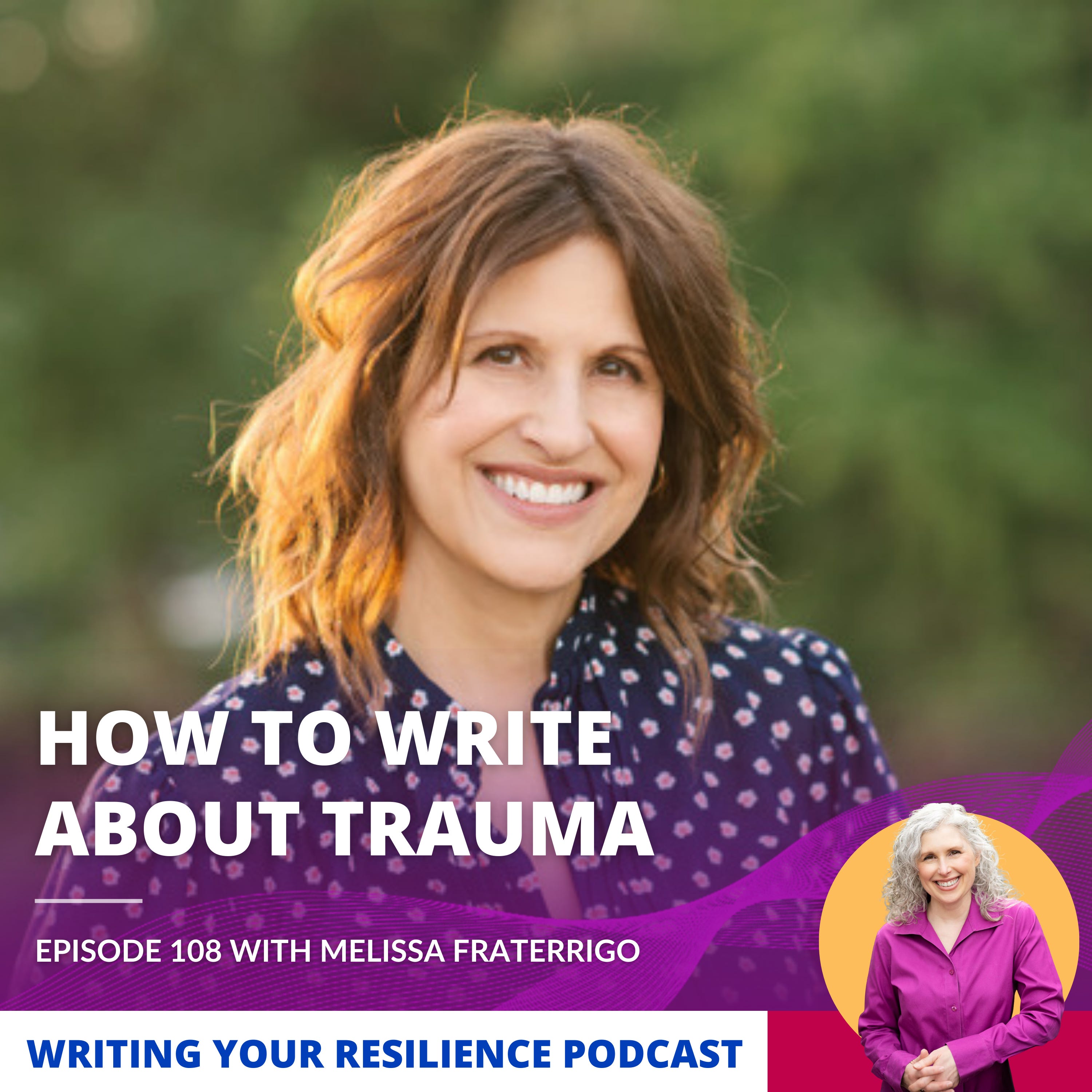
Writers, feeling stuck on how much detail to share—or how to connect scattered moments when writing about trauma? A memoir-in-essays might be your way in. This week, I’m joined by Melissa Fraterrigo, author of The Perils of Girlhood, to explore memoir vs. memoir-in-essays, using memory as a portal to story, and trusting your reader to know what to show—and what to leave unsaid.
Red-Hot Writers
Are you a subscriber with a late January or February publication? Reply to this email with the title and link so I can share your writing with our community. The deadline for this month’s Red-Hot Writer List is 2/20/26.
While I will link to pieces that promote a thoughtful dialogue between humans, I will not publish anything that promotes hate or demeans or denigrates marginalized communities
Sex in your post is okay, but I don’t promote erotica
Posts to your blog or personal Substack and marketing-focused posts do not qualify
Milestone Makers
Are you a subscriber who’s reached a late January or February milestone? Reply to this email so we can celebrate your success. Milestones could be birthdays, reaching a specific goal, or hitting a benchmark on a long-term project. The deadline for this month’s Milestone Makers List is 2/20/26.
If you or someone you know needs help, call 1-800-273-8255 for the National Suicide Prevention Lifeline. You can also text HOME to 741-741 for free, 24-hour support from the Crisis Text Line. Outside of the U.S., please visit the International Association for Suicide Prevention for a database of resources.
If you’ve read this far, thank you. You can support this newsletter and yourself with quarterly Ask Me Anything sessions and occasional Writer’s Support sessions by becoming a paid subscriber. My first ask me anything session is scheduled for March 2, 2026. And stay tuned for my first Human Design for Writers session, scheduled for March 25, 2026.
I also lost my brother (and father) to suicide. You wrote, "...keep writing, keep revising the story you get to live, keep feeling my love." That deeply touched me, Lisa. Thanks for sharing this.
Your story about Joe and the grief you felt after his passing and still feel 29 years later makes me think of my Uncle, who lost his brother, my father, at the age of 21. He never talked of his grief, never expressed it, and his children ( my cousins) were told by their mother not to ask him about his brother because it would "make him sad." I imagine he carried many of the feelings you did. When I got into my 40's, I finally started asking my Uncle about his brother, my father, and I did it by focusing on the things he and my father loved to do...as a way to focus on his life, not on how he died. I'm glad the sun came out on the day you remember your brother's passing.